
Woodburn Previous Residents by Era
Previous residents are found by combining several records that answer different questions. The Marion County Assessor supplies a present-day parcel bridge, while the Clerk's deed systems provide title events and historic party names. Directories, censuses, and maps can add time-specific household and place context. Start with the source whose period matches the question, and keep the source name, date, and record role with each note. A person named in a deed, tax record, or map-related file is not automatically a person who lived at the Woodburn property.
| Era source | Years it covers | Where held | What it shows |
|---|---|---|---|
| Current recorded-document search | 1974-present | Marion County Clerk Digital Research Room | Modern document trail, parties, dates, and legal-description clues. |
| Historic deed index | County page: 1855-1976; portal: 1850-1976 | Marion Clerk historic Deeds Search | Direct and indirect parties, dates, and historic instrument categories. |
| FamilySearch Marion County records | Indexes 1855-1976; deeds 1854-1920 | FamilySearch image and browse collection | Deed-index and deed-image fallback, subject to collection access conditions. |
| Polk, telephone, and street-guide volumes | 1889-90; documented segments 1902-1960 with gaps | WHC, library, and Gale inventory | Year-specific name, business, telephone, or street-guide clues. |
| Federal and Oregon census material | Federal rolling 72-year release; Marion materials include 1845, 1865, 1895, and 1905 resources | Census sources and Oregon State Archives | Household, location, age, and occupation context for the date recorded. |
| Maps and aerials | 1878 atlas; 1890-1913 Sanborns; 1961 aerials | City of Woodburn and Library of Congress | Street, structure, and land-use chronology, not person identity. |
For a current address, obtain the tax lot and legal description through the assessor first. For a nineteenth-century or early town question, use the family-name, directory, and archive route as well. The next record may be at the Clerk counter, a library collection, an image collection, or a focused City request rather than in a single online search screen.
Woodburn Previous Resident Deed Split
Marion County's online deed access has a useful but important split. The County Records and Archives page labels the historic deed search as 1855-1976 and the current recorded-documents route as 1974-present. The historic portal itself says documents exist for 1850-1976. Both date statements should stay in the research notes exactly as published; they are not reconciled here. For a transaction in 1974-1976, search both the historic and current systems because a result can appear on one route rather than the other.
The historic search is party, date, and instrument keyed. It offers direct party, meaning grantor, and indirect party, meaning grantee, along with optional date ranges and instrument types. It has no address or tax-lot field. The current Digital Research Room offers party, document, date, and legal-description controls. A parcel's legal description and the names carried forward from one transaction to the next are therefore more reliable links than a bare street address.
Explore the FamilySearch Marion County Records collection when the online index needs an image or browse-based follow-up. This collection includes Marion deeds and index material, making it a documented fallback for a date or party that does not resolve in the Clerk route.
FamilySearch images can help locate an historic record, but the Clerk remains the custodian for recorded-document questions and copies. The Clerk permits public searching and viewing at its office without charge; copies are available over the counter or by mail.
Trace Woodburn Previous Resident Deeds
A deed chain follows ownership, not every person who occupied a home. Begin at the Marion County Assessor with the situs address, account number, map-tax-lot, or subdivision. Its public form has no owner-name search category. A returned parcel card can supply the owner name, owner mailing address, situs address, map tax lot, property ID, legal description, and subdivision. The owner mailing address is tax correspondence and can differ from the property location.
- Locate the property with the assessor and record its current owner, map-tax-lot, legal description, and any document or sale reference shown.
- Search the current owner's acquisition in the 1974-present Digital Research Room, using party, date, or legal-description tools to find the relevant deed.
- Transcribe the seller, buyer, recording date, document number, document type, and legal description from the document detail.
- Search the seller as a prior grantee, then repeat the sequence backward through the next acquisition.
- At the historic boundary, use the direct and indirect party index, check both systems in 1974-1976, and ask the Clerk for counter or copy help when the chain will not resolve online.
The recorded terms below identify the role a name holds in the chain. They keep a title transaction separate from a conclusion about occupancy.
- Grantor
- The party transferring an interest in a recorded document. The historic Marion index labels this the direct party.
- Grantee
- The party receiving an interest. The historic Marion index labels this the indirect party.
- Chain of title
- The sequence of recorded transfers connecting one ownership event to an earlier one. It is not a roster of everyone who lived at the address.
- Legal description
- The lot, block, subdivision, township-range, or other recorded land description. It often survives an address change better than a street number.
When an online result is incomplete, the Marion County Clerk's recording office is at 555 Court St. NE, Suite 2130, Salem. It posts weekday hours of 8:30 a.m. to 5 p.m. and a recording line at 503-588-5225. Supply a party, legal description, approximate date, document number, or book and page when asking about a search or copy.
Woodburn Previous Residents and Households
Owners are only one part of a past-household question. A Polk, telephone, or street-guide volume can supply a dated listing, while a released census can show household composition and other context. Neither should be stretched beyond its date or coverage. The regional collection details belong on the Woodburn City Directory page; here, their role is to test whether a recorded ownership trail aligns with a household clue.
Use this process flow: directory or street-guide year → exact transcription → closest released census → tax lot and deed trail → probate, cemetery, or newspaper endpoint. Compare a name with the household group, occupation or place wording, township or precinct, and address context. A name disappearing from a directory can reflect a move, a death, a listing practice, a missing volume, or a different spelling.
Oregon Historical Records Index searches retain original spellings. Its guidance recommends trying surname-only searches, omitting periods, and then narrowing with a given name or county. FamilySearch's Marion County collection can be browsed around index numbers when a surname is absent, especially because some related record images can be faint, unnumbered, or mixed with an out-of-county certificate.
Note: A household source describes the people recorded for its own date, while a deed describes a title event. They should be compared, not merged into one claim.
Woodburn Previous Residents and Halsey
Pre-incorporation research needs a place-name check. Woodburn was known early as Halsey, was platted in 1872, and incorporated in 1889. A person, address, or place may be filed under Halsey, French Prairie, rural Marion County, or another contemporary wording rather than the modern city name. Search those variants separately in directories, newspapers, archives, and map sources.
The same caution applies to older county material. The Oregon State Archives says the area began as Champooick or Champoeg District, became a county in 1845, was renamed Marion in 1849, and reached current boundaries in 1854. An 1840s record may therefore use an earlier jurisdiction label. Preserve the original spelling in a transcription, then note the modern equivalent separately.
Woodburn Previous Resident Map Sequence
Maps can test whether an address form, building, or street pattern fits the period of a household or deed clue. Woodburn's evidence stack runs from 1878 atlas excerpts to Sanborn sheets dated 1890, 1892, 1894, 1900, 1906, and 1913, followed by the City's March 29, 1961 aerial panels and modern tax lots. That sequence is a comparison tool: it helps locate a structure in time, but it does not identify its occupants.
The Woodburn Historical Aerial Photos and Atlas page supplies the city-hosted atlas and aerial material. It can be paired with a legal description, directory date, or recorded document while keeping each source's limit clear.
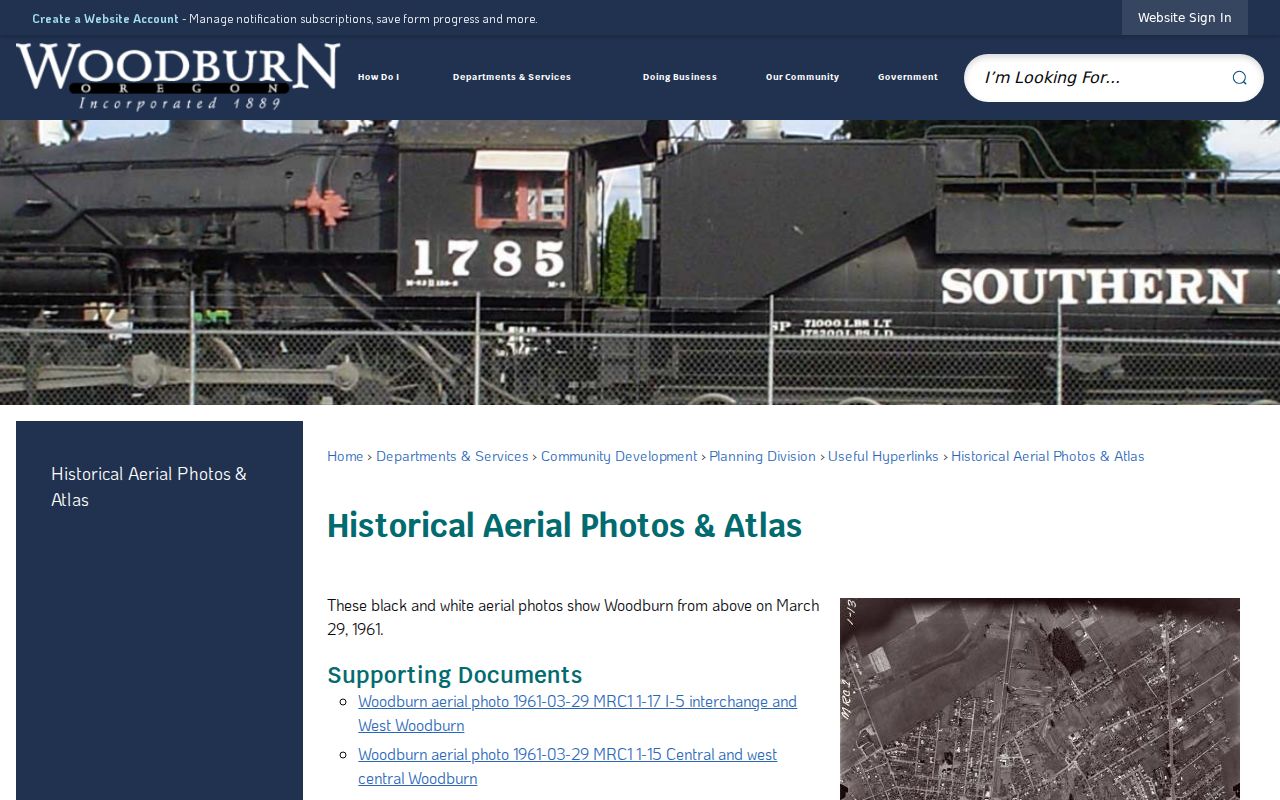
The aerial and atlas views are strongest when they explain why a street or structure looks different across decades. Use the current tax-lot record and original deed or survey material when an exact land boundary matters.
Woodburn Past Resident Research Help
Willamette Heritage Center provides a local house-history fallback after online searches. Its public research service specifically recognizes the question, “Who used to live in my house?” It can search cataloged material, returns an inventory through a free reference request, and offers appointment-based reading-room research. The first 15 minutes of staff research are free; additional research is listed at $60 per hour. Its archive includes regional photographs and personal, business, and organizational materials.
Woodburn Public Library and the Woodburn FamilySearch Center are additional in-person routes for catalog, local-book, computer, scanner, and printer access. For a construction or alteration date, Woodburn Building and Community Development records are a separate source: the researched city pages did not establish a public historic address-result database, so a focused public-record request should name the address and time range. A request seeks existing records, not a compiled list of people.
Woodburn Previous Residents Endpoints
A title or directory trail often ends with a record outside the property systems. Oregon Historical Records Index includes Marion County estates, probates, naturalizations, divorces, guardianships, and other historic name groups. FamilySearch lists Marion probate and naturalization material among its collections. A death, estate, cemetery, or newspaper notice can add an endpoint only after the person is matched with the address and date sequence.
For local newspaper context, Historic Oregon Newspapers permits date, city, county, phrase, and language searching. Woodburn Independent backfile availability was not verified as a comprehensive online search, so ask Woodburn Library, WHC, or the paper about a specific date. Belle Passi and St. Luke cemetery contacts are leads, not verified online person indexes. When a record remains uncertain, report it as unresolved and return to the relevant custodian or archive channel.