
Woodburn City Directory Collections
Woodburn's strongest documented city directory trail is regional, not a separate shelf bearing only the city name. R. L. Polk & Co. of Portland issued the Salem City and Marion County series, including an 1889-90 title and later directories that included Marion County towns. A 1915 title describes private citizens, businesses and professional firms, plus civic and business reference material for Salem and the county towns. The Willamette Heritage Center catalog further identifies a Woodburn alphabetical name list, city officials list, and business directory within the Polk series. Read the named volume before deciding what one particular entry contains.
| Collection | Years located | Where held | Access route |
|---|---|---|---|
| Polk Salem City and Marion County directories | 1889-90 and later regional volumes | WHC catalog and regional collections | Request cataloged material or arrange reading-room research. |
| Salem directory run including Woodburn | 1902-1911; 1913-1924 | Gale microform inventory | Use the inventory to locate a volume, then inspect its Woodburn coverage. |
| Salem, Silverton, and Woodburn segments | 1928/29-1935; 1936/37-1938/39; 1940/41-1942; 1945, 1947, 1949 | Gale inventory | Collection map only, not proof that every year or name appears. |
| Business and telephone guides | 1954, 1955, 1960, and 1976 documented volumes | WHC catalog | Ask to inspect the actual volume and its geographic section. |
Woodburn Public Library provides a nearby starting point through its Digital Resources, including Ancestry Library Edition's directory, census, map, and family-history material. The CCRLS catalog and the library's interlibrary-loan service are useful when the needed volume is not locally available. The deeper archive fallback is the Salem-based Willamette Heritage Center library and archives, whose collections are noncirculating.
Woodburn Directory Years and Gaps
The documented run has real breaks. The Gale inventory lists 1902-1911 but notes missing 1903, 1904, and 1906. Its 1913-1924 segment reports missing 1914, 1916, and 1918-1923. The next documented segments include 1928/29-1932 and 1932-1935, with 1933 missing from the latter segment. Woodburn-specific regional volumes appear again in the 1936/37 through 1949 group, followed by business and professional guides through the final reviewed 1960 entry.
Those dates describe located holdings, not continuous publication or complete Woodburn coverage. In particular, 1960 is the last Gale entry reviewed here, not proof that printing ended then. A missing volume may call for a telephone directory, Capital Press street guide, a census, or an archive catalog search instead of an assumption that the person was absent.
- 1889-90: Polk's Salem City and Marion County title establishes the early regional directory trail.
- 1902-1924: Located Salem runs include Woodburn but have documented missing years.
- 1928/29-1949: Regional segments return in several short runs and named Woodburn editions.
- 1954-1976: Capital Press and telephone volumes supply different, year-specific address and business clues.
Note: A dated directory line is evidence for that volume's period, not proof of a continuous stay before or after it.
Woodburn Library Directory Access
For a local first check, Woodburn Public Library offers licensed digital research material rather than a promise of an open, searchable Polk run. Its Digital Resources page identifies Ancestry Library Edition as a source for census, vital, immigration, court/legal, directory, photo, and map material. The library also offers Oregon's Answerland reference service. Holds can be placed by phone during library hours, and the card rules describe a free full-service card for residents inside city limits.
See the library's digital-resource listing before visiting or asking staff about a particular year. The image records the library's Ancestry Library Edition resource, a practical doorway to historical directory and census research.
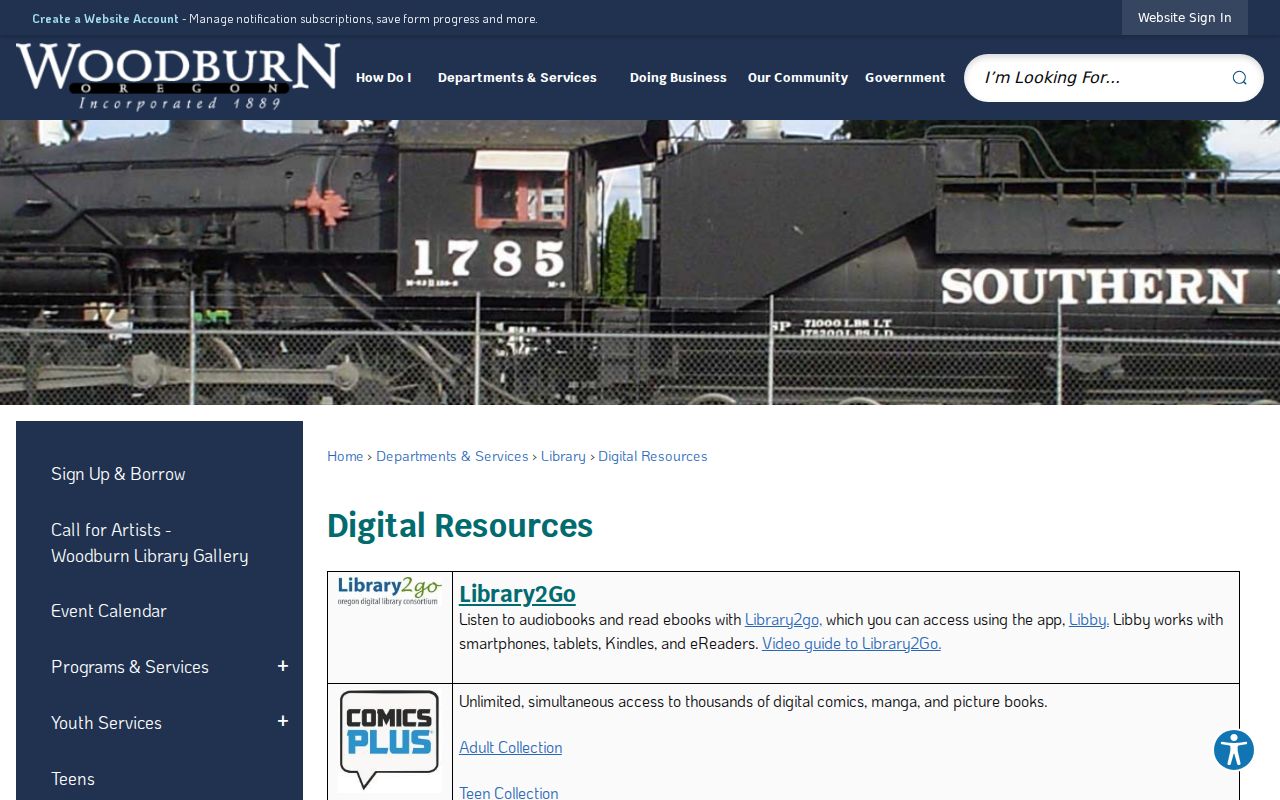
A library database result still needs the printed-year, title, and location details preserved alongside the name. When a volume is unavailable or a local-history question needs broader context, WHC accepts free reference requests that return an inventory of cataloged material; its first 15 minutes of staff research are free, and further work is priced by the archive.
Reading a Woodburn City Directory
No authoritative source reviewed an openly viewable Woodburn Polk entry. That means a city directory search should document only the portions the catalog and titles support, not fill an imagined line with spouse marks, occupations, owner symbols, or address abbreviations. The inventory below is a record of supported directory layers. It is not a sample Polk entry and does not promise that every line has every field.
| Alphabetical private-citizen list | A resident-name list, including a Woodburn alphabetical list in the WHC catalog; use it to begin a name and year search. |
|---|---|
| Business and professional layer | Businesses and professional firms, with a Woodburn business directory; use it as a corroborating affiliation clue. |
| Civic-reference layer | Officials, schools, churches, banks, newspapers, and societies, including a Woodburn officials list. |
| Taxpayer layer | The 1915 title advertises assessed value and post-office address, a historic property or postal clue rather than proof of residence. |
| Street-guide layer | The 1954 Capital Press catalog identifies street guides; inspect the guide itself for coverage and format. |
These terms describe possible directory organization, not fields proved in every Woodburn line. Confirm the volume's own front matter before interpreting a mark or heading.
- Criss-cross directory
- A directory arranged by address or street rather than primarily by surname. Woodburn sources verify some street-guide material, but not a criss-cross section in every decade or volume.
- Householder index
- An index organized around a household or address. Its presence and design must be confirmed in the individual directory.
- Abbreviation key
- A volume's own explanation of shortened terms and marks. A line-by-line Woodburn abbreviation guide has not been verified, so photograph or transcribe the key in the volume being used.
Woodburn Directory Search Vocabulary
Historic Woodburn did not always file under the modern city label. City history says the early town was known as Halsey, was platted in 1872, and incorporated as Woodburn in 1889. Earlier family or place material can instead appear under Halsey, French Prairie, rural Marion County, or an older county name. Preserve the wording used by the source before standardizing it in personal notes.
The Oregon Historical Records Index supplies a useful second check for a hard-to-find surname. Its guidance says original spellings are retained, a surname-only search can work better, periods should be omitted, and a given name or county can narrow results. That is especially useful when a directory gives initials, a shortened given name, or a town label that differs from a modern search.
Woodburn City Directory Household Trails
Directory research works best as a sequence of dated snapshots. Start with the known person, address, and approximate year, then select the closest Polk, South Marion, telephone, or Capital Press volume. Transcribe the printed wording exactly, including initials, name order, business label, town or post-office wording, volume year, and page. A directory entry can suggest a household or move, but it needs a second source before it becomes a family conclusion.
- Find the closest available directory or telephone volume for the person, address, or year.
- Copy the line exactly and repeat the name search with surname-only and given-name variants in OHRI or FamilySearch.
- Pair the directory year with the closest released federal census or Oregon census record, comparing household composition, occupation or place, township or precinct, and address context.
- For an address question, carry the street-guide clue to the assessor's map-tax-lot and legal description, then to the direct and indirect deed indexes.
- Use probate, estate, cemetery, official historic vital access, or a newspaper notice only as an endpoint check matched to the correct person.
Federal census access follows the rolling 72-year public release pattern. The State Archives also identifies 1845 Champoeg and 1905 Marion County census material. Same names can belong to different households, so compare the full group, not one surname alone.
Woodburn Directory Maps in Sequence
Woodburn has an unusually useful place-history stack for testing a directory's address context. The city hosts 1878 atlas excerpts and aerial panels dated March 29, 1961. Library of Congress holds Woodburn Sanborn editions from 1890, 1892, 1894, 1900, 1906, and 1913. A map may show a street label, footprint, construction-use clue, or business name, while an aerial can show development between map dates. Neither is a list of household members.
Use the Woodburn historical aerials and atlas with the relevant directory year, then compare the physical setting against a tax lot or recorded document when an address has changed form. This comparison prevents a modern parcel view from being projected backward onto an earlier directory line.
Note: Street or structure context can corroborate a date, but a map alone does not identify the person connected to a historic directory listing.
Opportunity News and Woodburn Names
Opportunity News adds a different kind of Woodburn community record to the directory shelf. The University of Oregon digitized 117 bilingual issues published from June 18, 1965 through March 25, 1968. The paper covered agricultural and migrant-labor community issues in English and Spanish, so a surname, organization, school, event, or Spanish-language term may appear there when a general regional directory is silent.
Search the Opportunity News collection with an exact name plus a place or date range, and keep newspaper evidence separate from vital or property records. The collection supports a date-specific community lead, not an automatic identity match.
Woodburn Directory Dead Ends
A blank city directory search can reflect a missing volume, a regional title, a spelling difference, or a listing format that did not include the person or address. It does not prove the person never lived in Woodburn. WHC's research service specifically recognizes former-householder questions, can search cataloged material, and offers appointment-based reading-room research. Woodburn FamilySearch Center also provides local books and records, computers, scanners, and printers for in-person genealogy work.
For a name that does not resolve, use the nearest census, OHRI's Marion County groups, FamilySearch's Marion County images, or a newspaper search before drawing a conclusion. For an address, use the legal description and deed route rather than assuming a modern street number appears in old volumes. Those alternate channels preserve the difference between a located record and an unanswered question.